

Journal of Veterinary Science & Medicine
Download PDF
Melophagus ovinus are wingless, blood-feeding flies. The Family Hippoboscidae includes M. ovinus and approximately three hundred species of winged forest flies (also known as louse flies) that infest sheep population [14]. As indicated in [Figure 1], M. ovinus are up to approximately 5 mm in length, and are leathery, brownish, hairy, dorso-ventrally flattened with six strong legs with obvious terminal claws and have no wings [15].
Summer shearing removes most or all of the ked population on a sheep. Some keds may fall from the fleece and die, and grooming by the sheep may further reduce ked numbers. M. ovinus infestation and distribution are restricted to cooler highlands in hot and humid tropics, with temperature playing a key role in its dynamics [3].
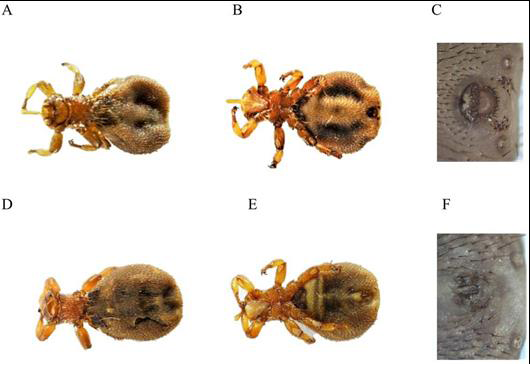 Figure 1:Morphology of sheep ked: Female M. ovinus in dorsal (A) and ventral (B) views, and posterior end (C); male M. ovinus in dorsal (D) and ventral (E) views, and posterior end (F) (Source: [2]).
During these physical examinations, the sex, age group, and physical condition of each sampled animal are recorded. Parasites are removed carefully and gently by hand and forceps to avoid damage to the body. Keds collected from their attachment sites can be placed in universal bottles containing 70% alcohol for preservation or transport for further identification [2].
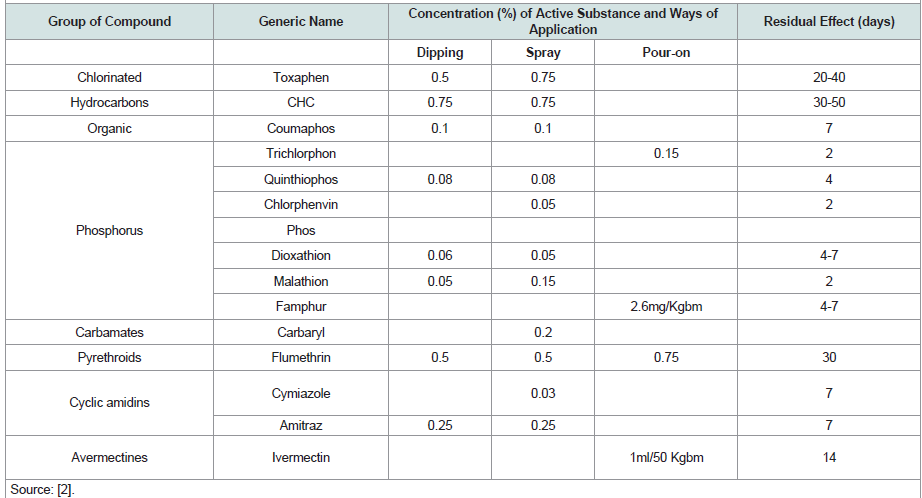 Table 1:Ways of application of acaricides for control of sheep ked.
 Table 2:Prevalence of sheep ked infestation in different parts of Ethiopia.
Review Article
A Review on Sheep Ked (Melophagus ovinus) Infestation: Biology, Epidemiology, Pathogenesis, Economic Impact, and Control
Mequannet Fentie1, Tewodros Alemneh1, and Mekonen Baylie2
1Woreta Town Agriculture, and Livestock & Fishery Resources
Development Office, South Gondar Zone, Woreta, Ethiopia
2Fogera District Livestock and Fishery Resources Development Office, South Gondar Zone, Woreta, Ethiopia
2Fogera District Livestock and Fishery Resources Development Office, South Gondar Zone, Woreta, Ethiopia
*Address for correspondence:Tewodros Alemneh, Woreta Town Agriculture, and Livestock & Fishery Resources Development Office, South Gondar Zone, Woreta, Ethiopia. E-mail Id: tedyshow@gmail.com
Submission: 29 July, 2026
Accepted: 20 October, 2026
Published: 30 October, 2026
Copyright: © 2026 Fentie M, et al. This is an open access article
distributed under the Creative Commons Attribution License, which
permits unrestricted use, distribution, and reproduction in any medium,
provided the original work is properly cited.
Keywords: Melophagus ovinus; Sheep ked; Epidemiology; Veterinary
Significance; Economic Impact; Control
Abstract
The sheep ked (Melophagus ovinus) is a wingless, obligate, blood-feeding
dipteran fly of the family Hippoboscidae that infests sheep worldwide, with its entire
life cycle completed on the host. Infestation causes blood loss and anaemia, pruritus,
restlessness, fleece and skin damage, reduced growth and carcass weight, and marked
downgrading and rejection of skins, resulting in substantial economic losses to sheep
production and the tanning industry. Transmission occurs mainly through direct contact,
particularly from ewes to lambs, and is modulated by environmental conditions, wool
type, host body condition, and management practices. Prevalence and intensity are
typically highest in cooler seasons and in long- or dense-wooled breeds, with lambs
more heavily infested than adults. Diagnosis relies on recovery and morphological
identification of adult keds from the fleece. Control depends largely on chemical
acaricides applied by dipping, spraying, or pour-on, together with strategic shearing
and improved husbandry; however, high costs, emerging resistance, and concerns about
drug residues and environmental contamination limit their sustainability. Integrated,
evidence-based control programs tailored to local ecology and epidemiology,
supported by surveillance, farmer education, and research into alternative and
complementary strategies, are essential to reduce the impact of sheep ked infestation
on animal health, welfare, and productivity. Therefore, this review synthesizes current
knowledge on the biology, epidemiology, veterinary significance, economic impact,
and control of M. ovinus.
Introduction
An estimated 42.9 million sheep are raised in different
agroecologies and production systems in Ethiopia for various
purposes, such as meat production, income generation, and skin
production, contributing significantly to the livelihoods of smallscale
farmers [1]. However, the contribution of sheep production to
the Ethiopian economy is adversely affected by several constraints,
including ectoparasites such as sheep keds. The sheep ked, Melophagus
ovinus, is a wingless dipteran fly of the family Hippoboscidae that
feeds on host blood through its piercing mouthparts. Its relationship
with the host is intimate and obligatory, and its entire reproductive
cycle takes place on the host. The female ked periodically produces a
single, fully grown larva, which becomes firmly attached to the wool
and forms a puparium [2]. Sheep keds feed on the blood of their hosts,
causing blood loss and potentially leading to anaemia [3]. They also
cause skin irritation and stimulate scratching, rubbing, and licking,
resulting in restlessness, fleece and skin damage, and reduced carcass
weight [4].
Furthermore, sheep ked infestation causes the downgrading and rejection of sheep skins [5], thereby adversely affecting productivity and reproductive efficiency [6]. Notably, the epidemiology of sheep ked infestation is influenced by environmental conditions and host factors. Transmission of M. ovinus occurs through direct contact with an infested sheep or through contact with environmental materials contaminated by keds that have dropped from infested sheep. Transmission occurs most frequently from ewes to their lambs [7]. Moreover, host factors, such as wool type, appear to be important determinants of infestation rates. Long-wooled breeds appear to be particularly susceptible [8]. In general, the prevalence and intensity of sheep ked infestation are highest during the wet season and lowest during the dry season [9]. Moreover, sheep in poor body condition, those that are improperly fed, and those exposed to cold conditions or debilitating diseases tend to carry heavier infestations because debilitated animals groom themselves less frequently, leaving the keds undisturbed [8].
Furthermore, sheep ked infestation causes the downgrading and rejection of sheep skins [5], thereby adversely affecting productivity and reproductive efficiency [6]. Notably, the epidemiology of sheep ked infestation is influenced by environmental conditions and host factors. Transmission of M. ovinus occurs through direct contact with an infested sheep or through contact with environmental materials contaminated by keds that have dropped from infested sheep. Transmission occurs most frequently from ewes to their lambs [7]. Moreover, host factors, such as wool type, appear to be important determinants of infestation rates. Long-wooled breeds appear to be particularly susceptible [8]. In general, the prevalence and intensity of sheep ked infestation are highest during the wet season and lowest during the dry season [9]. Moreover, sheep in poor body condition, those that are improperly fed, and those exposed to cold conditions or debilitating diseases tend to carry heavier infestations because debilitated animals groom themselves less frequently, leaving the keds undisturbed [8].
Sheep ked infestations can have detrimental effects on animal
health and productivity and may also contribute to the transmission
of pathogenic bacteria and at least one virus associated with
a serious sheep disease, bluetongue [10,11]. Small ruminants
contribute significantly to household stability and income through
the production of meat, milk, skin, and wool, while also fulfilling
customary social and religious responsibilities. Sheep are the most
dominant small ruminants in Ethiopia, contributing up to 63% of
the country’s cash income and 23% of the value of food subsistence
derived from livestock production [12].
Understanding the ecology and epidemiology of sheep ked infestation, including interactions between the parasite and its host under specific climatic, management, and production conditions, is essential for implementing sustainable sheep ked control programs in grazing sheep [13]. Thus, chemical control and good management practices are important methods for preventing and controlling sheep ked infestation [8]. Therefore, this review aims to provide an overview of sheep ked (M. ovinus) infestation in sheep, focusing on its epidemiology, effects on sheep health, productivity, and skin quality, as well as available control and prevention strategies.
Understanding the ecology and epidemiology of sheep ked infestation, including interactions between the parasite and its host under specific climatic, management, and production conditions, is essential for implementing sustainable sheep ked control programs in grazing sheep [13]. Thus, chemical control and good management practices are important methods for preventing and controlling sheep ked infestation [8]. Therefore, this review aims to provide an overview of sheep ked (M. ovinus) infestation in sheep, focusing on its epidemiology, effects on sheep health, productivity, and skin quality, as well as available control and prevention strategies.
Insights to The Literature:
General Description and MorphologyMelophagus ovinus are wingless, blood-feeding flies. The Family Hippoboscidae includes M. ovinus and approximately three hundred species of winged forest flies (also known as louse flies) that infest sheep population [14]. As indicated in [Figure 1], M. ovinus are up to approximately 5 mm in length, and are leathery, brownish, hairy, dorso-ventrally flattened with six strong legs with obvious terminal claws and have no wings [15].
Life Cycle:
The entire life cycle of the sheep ked is completed on the host,
with no free-living stages. Adult female M. ovinus mate within hours
of emergence from the puparium and, after about fourteen days —
the period required for ovarian development, egg production, and
hatching to release the larva within the female’s abdomen — deposit
a single, fully developed larva into the fleece. A female then produces
approximately one larva per week for up to fifteen weeks. Each larva
is glued to the wool and pupates within a few hours, and the adult
emerges after a further three to four weeks and begins to blood-feed.
Pupal development is temperature-dependent, with an optimum of
20–30°C, and the life cycle can be completed in four to five weeks
[16].
Epidemiology and Host Range:
Melophagus ovinus is a parasite of sheep worldwide, although
very occasional records exist from other domestic and free-ranging
animals. Transmission occurs either through direct contact with
an infested sheep — most often from ewes to their lambs, possibly
resulting in a gradual transfer of the ked population to the lambs
— or through contact with an environment containing adults that
have dropped from the fleece [7]. Crowding therefore enhances
transmission. Ked numbers on ewes often peak during pregnancy,
although the reasons for this remain unknown. Wool type appears to
be an important determinant of infestation rates, with long-wooled
breeds being particularly susceptible [8]. In general, the prevalence
and intensity of keds on sheep are highest in winter and lowest in
summer, and highest on lambs and lowest on adult sheep [9]. Fleece
type also influences ked populations; lambs are generally infested
with young keds, whereas adult sheep carry older ones [7].Summer shearing removes most or all of the ked population on a sheep. Some keds may fall from the fleece and die, and grooming by the sheep may further reduce ked numbers. M. ovinus infestation and distribution are restricted to cooler highlands in hot and humid tropics, with temperature playing a key role in its dynamics [3].
Pathogenesis:
The major significance of keds lies in the damage they cause to
the fleece and the resulting downgrading of skin value. The activities
of adult keds cause irritation, and the sheep’s attempts to relieve this
may further damage the fleece and reduce production. In addition,
very heavy burdens of M. ovinus may lead to anaemia through blood
loss [17]. Sheep ked feeding reduces live weight and wool quality and
causes restlessness, irritation, severe dermatitis, anaemia, and severe
physical harm, while direct injury reduces skin quality [18].
Diagnosis:
History and clinical signs may be helpful, but recovery and
identification of adult keds from the fleece confirm the diagnosis.
Collection of sheep ked from hosts:
Sheep ked specimens are usually obtained from their hosts. It is
rarely possible to examine the entire body of a sheep thoroughly, but
in some studies the animal is well restrained on the ground or held
in a standing position and the whole body is then searched. It is often
more efficient to examine a sample of fixed areas of the host, which is
particularly useful for sheep ked, as they are known to have preferred
predilection sites [19].
Preservation of sheep ked samples:
Following proper restraint of the sheep, clinical examination can
be performed as described by Kumsa et al. [9]. The skin can be palpated
across all parts of the animal for the presence of parasites, and gross
lesions suggestive of clinical sheep ked infestation are recorded, with
infested animals considered positive [9]. Visual inspection of the skin
and wool should also be conducted to detect parasites.During these physical examinations, the sex, age group, and physical condition of each sampled animal are recorded. Parasites are removed carefully and gently by hand and forceps to avoid damage to the body. Keds collected from their attachment sites can be placed in universal bottles containing 70% alcohol for preservation or transport for further identification [2].
Laboratory identification of sheep ked:
Sheep ked can be identified with the naked eye or a simple ×10
magnification hand lens based on their morphological features; a
stereomicroscope with low magnification (×10 to ×40, preferably
up to ×80) is required [15]. Keds are kept in a petri dish under the
preserving liquid for preliminary sorting, as some characteristics,
such as the hairy appearance, are frequently best observed when
immersed in liquid. For final identification, it is critical to examine
keds that are dry and free of glycerol deposits from the preservative;
they should be blotted dry with tissue paper. Sheep keds frequently
appear dirty when dry, and the best way to clean them is to use an
ultrasonic cleaner for 5 minutes while immersed in a water solution
containing 5% sodium or potassium hydroxide [3].
Control Methods:
Understanding the ecology and epidemiology of the sheep
ked, as it interacts with the host in specific climatic, management,
and production environments, is required for the successful
implementation of rational and sustainable control programs in
grazing sheep [13]. Ked infestations may be reduced by shearing and
by a wide range of pesticides. Shearing removes many puparia and
adults; however, in most cases, efficient and reliable control of sheep
ked is based on chemical treatment (acaricide application), which is
frequently applied without a local understanding of the appropriate
ecology or epidemiology [20]. The most common control methods
are briefly described below.
Chemical control:
In Ethiopia, the traditional method of controlling sheep ked
infestation is the application of acaricides, either by hand spraying or
hand dressing. Appropriate and timely strategic control measures are
essential to reduce the negative effects of sheep ked [2]. Acaricides are
required to control sheep ked infestations [Table 1]; however, their
use is limited by high costs, resistance, and concerns about residues
in food and the environment. Thus, decisions should be made on
whether to use intensive, strategic, threshold, or other acaricide
application systems [21].
Economic Impact:
The feeding of keds causes widespread pruritus, exacerbated by
rubbing, scratching, and biting in response to the irritation. In young
lambs, blood loss to keds may be sufficient to cause patent anaemia,
with consequent reduction in growth rates; higher body weights
have been recorded in control Merino sheep compared with infested
sheep [2]. Sheep ked can affect skin and wool quality by piercing the
mouthparts and creating holes in processed skin; feeding may also
allow bacteria to pass through the skin, resulting in local abscesses
that damage skin quality more severely than the feeding hole itself
[12]. According to estimates, one million USD is lost each year in
Ethiopia due to the rejection of downgraded skins attributed to sheep
ked damage [18].
Current Status of Sheep ked Infestation in Ethiopia:
The prevalence of sheep ked infestation has been reported
from various parts of Ethiopia over different years. For instance, a
prevalence of 33.57% was recorded in Wogera district, while an
overall prevalence of 7.55% was reported in Berehet woreda, Tigray
region, among sheep reared under the extensive production system.
According to Shiferaw [22], the prevalence of sheep ked in different
parts of Ethiopia was 6.70%, 3%, 20.10%, 32.57%, 11.67%, 16.40%,
and 14.2% in Tigray, Bahir Dar, Gondar, Kombolcha, Tigray region,
Central Oromia, and Southern Ethiopia, respectively [22] [Table 2].
Conclusions and Recommendations:
Sheep ked (M. ovinus) infestation remains a persistent and
economically important threat to sheep health, welfare, and
productivity, and to the tanning industry, while its control is
complicated by over-reliance on chemical acaricides, rising costs
and resistance. Sustainable reduction of this burden therefore
requires a shift from reactive treatment to integrated, evidence-based
management. Therefore, the following measures are forwarded as
recommendations: (1) implement integrated control combining
strategic shearing, targeted acaricide use, and improved husbandry;
(2) strengthen surveillance to map prevalence and guide timely
interventions; (3) educate farmers and extension workers on early
detection, correct acaricide application, and shearing; (4) promote
research on alternative and complementary tools, including
biological and botanical agents and vaccines; (5) monitor acaricide
resistance and enforce rational, quality-assured acaricide use; and
(6) foster collaboration among researchers, veterinary services, the
tanning industry, and farmer organizations to deliver coordinated,
sustainable control programs.
Acknowledgements:
The authors express their sincere gratitude to the staff of the
University of Gondar, College of Veterinary Medicine and Animal
Sciences, for their valuable teaching, guidance, and inspiration.
The authors are also deeply grateful for the academic environment,
technical support, and constructive feedback provided throughout
the preparation of this review. Their commitment to excellence in
veterinary education and research has greatly contributed to the
successful completion of this work.
References
Citation
Fentie M, Alemneh T, Baylie M. A Review on Sheep Ked (Melophagus ovinus) Infestation: Biology, Epidemiology, Pathogenesis, Economic Impact, and Control. J Veter Sci Med. 2026;14(1): 1